

Critical Appraisal & Evidence-Based Medicine
AKT High-Yield Breakdown
Critical appraisal is the ability to assess the quality, validity, and relevance of research evidence. The AKT tests study design recognition, bias identification, interpretation of statistical results, and the hierarchy of evidence. This section underpins all evidence-based clinical decisions.
What You'll Learn
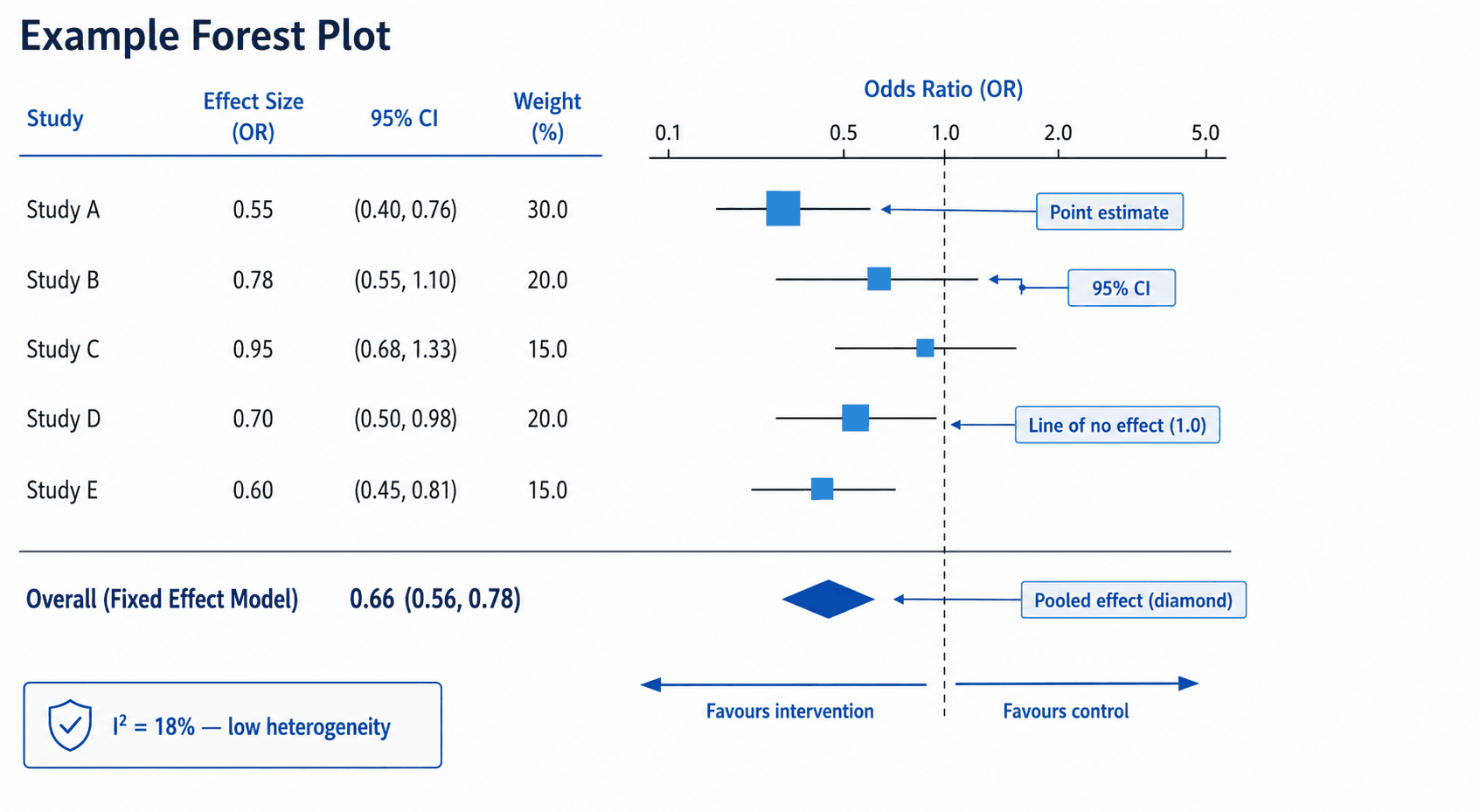
Master study design hierarchy, the difference between randomisation and blinding, intention-to-treat vs per-protocol analysis, how to interpret forest plots and I² heterogeneity, CONSORT and PRISMA frameworks, and the clinical significance of confidence intervals and p-values.
Practise Critical Appraisal & EBM MCQs
From study design hierarchy and intention-to-treat analysis to forest plot interpretation, I² heterogeneity, SnNout/SpPin mnemonics, and the difference between statistical and clinical significance — tackle focused MCQs across the full Critical Appraisal curriculum.
Study Designs and Hierarchy of Evidence
Different study designs answer different clinical questions and carry different levels of evidence. Recognising the design from a description is a core AKT skill.
Observational Studies
- Case report/case series: description of one patient or a small group; hypothesis-generating only; lowest level of evidence; useful for rare conditions or unexpected findings
- Cross-sectional (prevalence) study: measures exposure AND outcome at a single point in time; calculates prevalence; cannot establish temporality (cause before effect); useful for planning services
- Case-control study: compares people WITH the outcome (cases) to those WITHOUT (controls) and looks back at exposure; retrospective; good for rare outcomes; efficient; calculates odds ratio; susceptible to recall bias
- Cohort study: follows exposed and unexposed groups forward in time to observe outcomes; prospective (usually); can establish temporality; calculates relative risk and incidence; expensive, slow; susceptible to loss to follow-up
- Ecological study: uses population-level data rather than individual patient data; cannot infer causation at the individual level (ecological fallacy)
Experimental Studies and Evidence Hierarchy
- Randomised Controlled Trial (RCT): gold standard for establishing causation; participants randomly allocated to intervention or control; eliminates selection bias; not always feasible or ethical
- Systematic review: comprehensive synthesis of all available evidence on a question using predefined methodology; highest quality evidence if well-conducted
- Meta-analysis: statistical pooling of results from multiple studies; increases statistical power; produces combined effect estimate
- Oxford Centre for Evidence-Based Medicine hierarchy: 1a — systematic review of RCTs; 1b — individual RCT; 2a — systematic review of cohort studies; 2b — individual cohort study; 3 — case-control; 4 — case series; 5 — expert opinion
Create your free account
You can preview topic pages for free. Create an account to start your revision setup, then upgrade when you are ready to unlock the complete high-yield notes and exam tips.