

Emergency Medicine
AKT High-Yield Breakdown
Emergency medicine in primary care focuses on recognising life-threatening conditions early, initiating appropriate immediate management, and knowing when and how quickly to escalate. The AKT tests the first steps of management, time-critical interventions, and red flag recognition — not full hospital-based protocols.
What You'll Learn
Master anaphylaxis management, the Sepsis 6 bundle, STEMI vs NSTEMI differentiation, stroke thrombolysis timing, acute asthma severity, DKA management principles, and the paracetamol overdose treatment threshold for the AKT.
Practise Emergency Medicine MCQs
From anaphylaxis adrenaline doses and the Sepsis 6 bundle to DKA potassium management, stroke thrombolysis windows, and paracetamol overdose treatment thresholds — tackle focused MCQs across the full Emergency Medicine curriculum.
Anaphylaxis
Anaphylaxis is a severe, life-threatening generalised hypersensitivity reaction. Prompt recognition and immediate treatment are essential.
Diagnosis
Anaphylaxis is likely when ALL THREE are present: sudden onset + life-threatening compromise (airway/breathing/circulation) + skin/mucosal changes. However, skin changes may be absent in up to 20% — do not exclude anaphylaxis without them.
- Airway: hoarseness, stridor, tongue/throat swelling, drooling
- Breathing: wheeze, tachypnoea, cyanosis, SpO₂ <92%
- Circulation: hypotension, tachycardia, pallor, collapse, loss of consciousness
- Skin: urticaria, angioedema, flushing, pruritus — present in ~80% of cases
- Common triggers: foods (nuts, shellfish, milk, eggs), drugs (penicillin, NSAIDs, contrast), Hymenoptera stings, latex
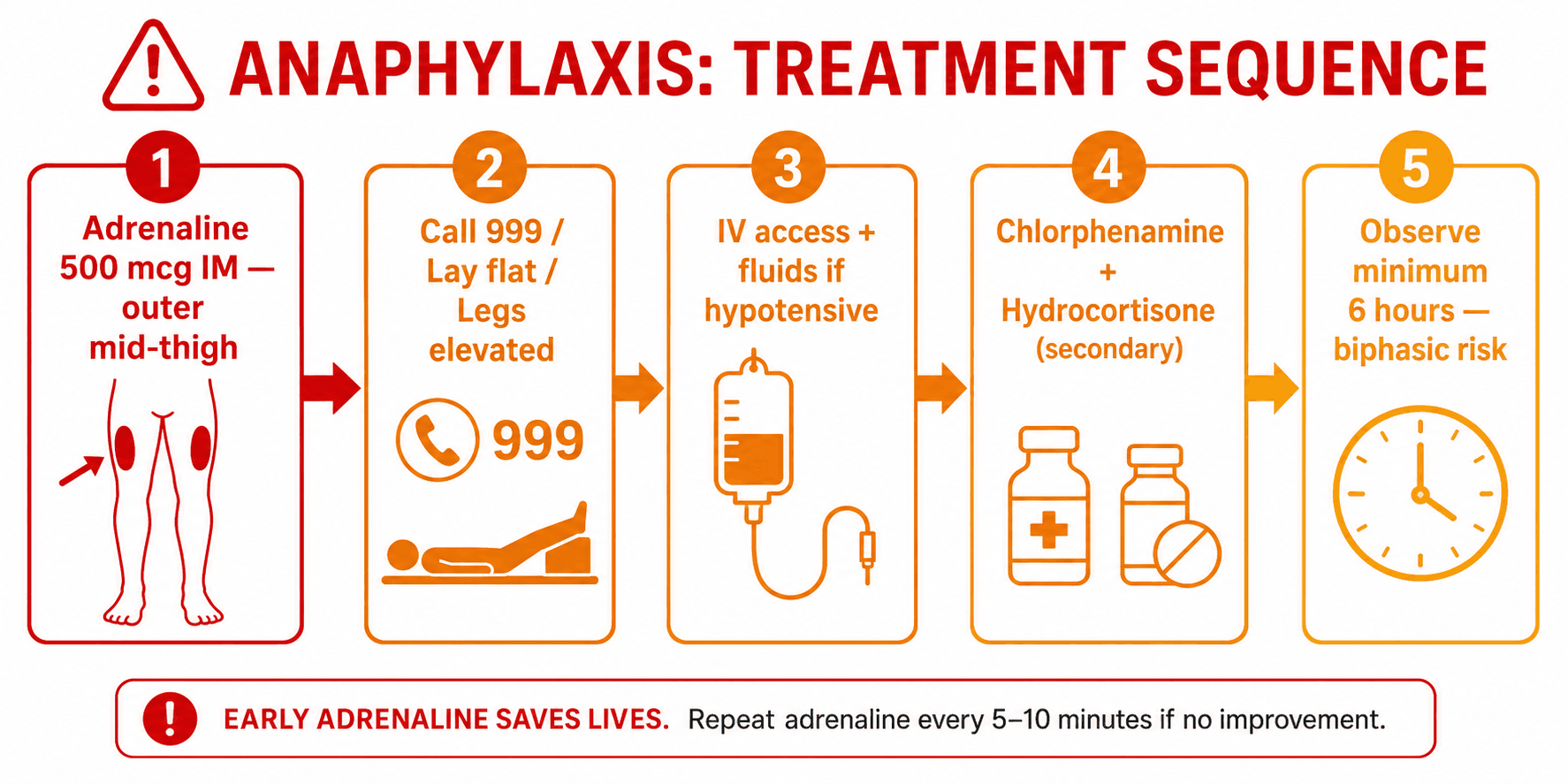
Management (ABCDE + IM Adrenaline)
Create your free account
You can preview topic pages for free. Create an account to start your revision setup, then upgrade when you are ready to unlock the complete high-yield notes and exam tips.