

Pharmacology & Prescribing Safety
AKT High-Yield Breakdown
Pharmacology and prescribing safety is one of the most reliably tested AKT domains. Questions cover drug calculations, monitoring protocols, interactions, adverse reactions, prescribing in special populations, and controlled drug regulations. The AKT tests both the factual knowledge and the clinical judgment to apply it safely.
What You'll Learn
Master opioid and steroid dose equivalences, drug monitoring thresholds (lithium, methotrexate, amiodarone, clozapine), CYP450 inducers and inhibitors, prescribing in renal and hepatic impairment, controlled drug schedule requirements, and the prescribing safety red flags that most commonly appear in the AKT.
Practise Pharmacology & Prescribing Safety MCQs
From drug dose calculations and opioid equivalences to DMARD monitoring schedules, P450 drug interactions, controlled drug schedules, and prescribing in renal and hepatic impairment — tackle focused MCQs across the full Pharmacology & Prescribing Safety curriculum.
Drug Dosage Calculations
Drug calculations are a non-negotiable component of safe prescribing. The AKT tests these directly — expect at least one calculation question per sitting.
Core formulas: Dose required (mg) = Weight (kg) × Dose per kg. Volume to give (mL) = (Dose required ÷ Stock concentration) × Volume of stock. Infusion rate (mL/hr) = Volume (mL) ÷ Time (hr). Show your working — units must cancel correctly.
Opioid Equivalence
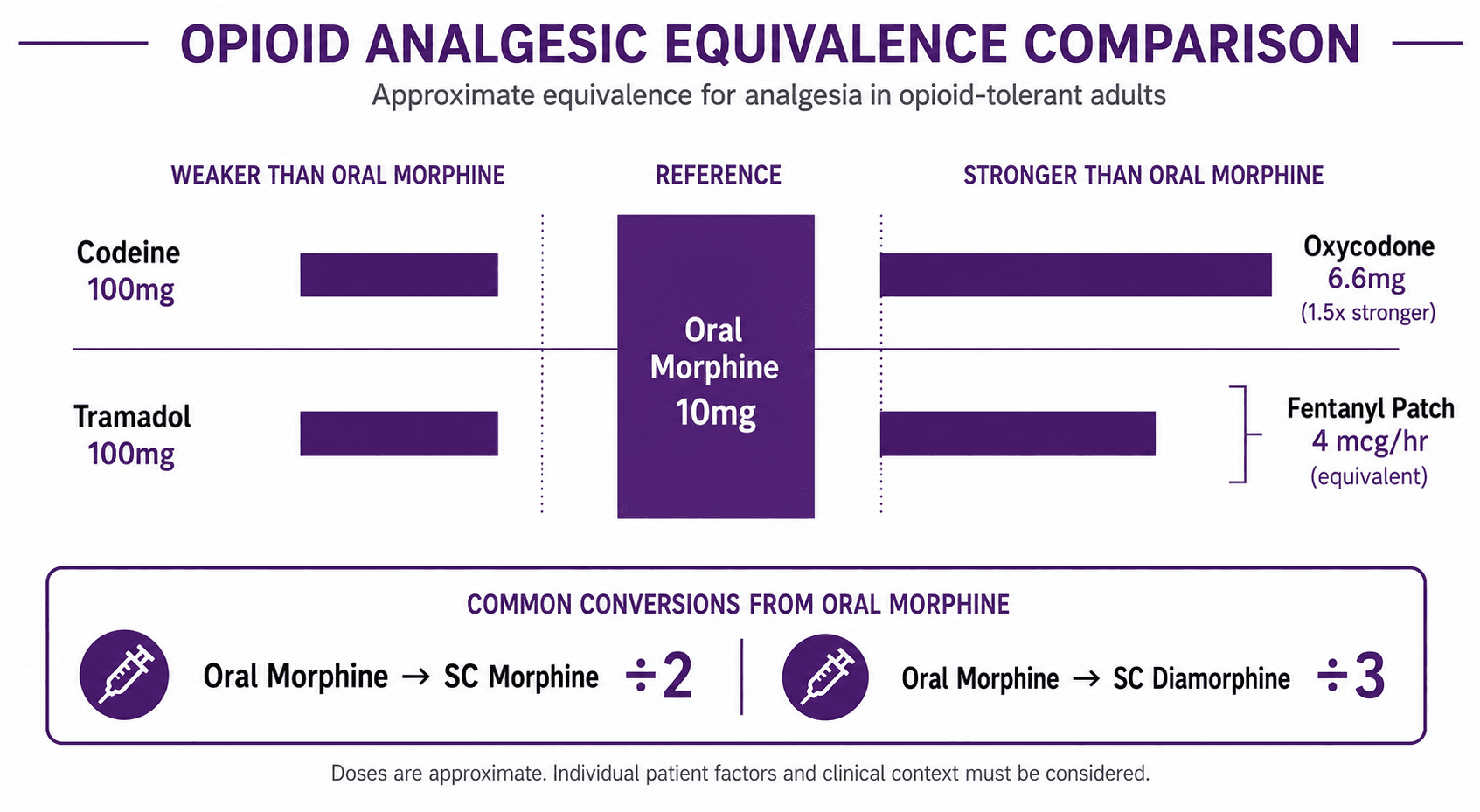
Opioid conversions (approximate, using oral morphine as reference): Codeine 60mg PO ≈ Morphine 6mg PO (ratio 10:1). Tramadol 100mg PO ≈ Morphine 10mg PO (ratio 10:1). Oxycodone 10mg PO ≈ Morphine 15mg PO (oxycodone is 1.5× stronger than morphine). Oral morphine to SC morphine: divide by 2. Oral morphine to SC diamorphine: divide by 3.
- Transdermal fentanyl 12 mcg/hr patch ≈ oral morphine 30 mg/day; 25 mcg/hr ≈ 60 mg/day — use conversion tables; patches take 12-17 hours to reach steady state and last 72 hours
- Codeine is CONTRAINDICATED in breastfeeding (ultra-rapid metabolisers convert to morphine → neonatal respiratory depression) and in children under 12 for pain/cough
- Tramadol lowers seizure threshold — avoid in epilepsy; serotonin syndrome risk when combined with SSRIs/SNRIs/MAOIs
- Oral morphine is unsafe in severe renal failure (eGFR <30) — active metabolite M6G accumulates causing respiratory depression; use oxycodone or fentanyl instead
Create your free account
You can preview topic pages for free. Create an account to start your revision setup, then upgrade when you are ready to unlock the complete high-yield notes and exam tips.